Most marinas look better in person than they do online. You’ve spent years perfecting your docks, training your staff, and maintaining your facilities, yet your digital footprint remains a liability.
If your website is just a digital brochure gathering dust, you aren't just missing clicks: you are leaking revenue. In the marine industry, your website is the User Interface (UI) of your business. It is the digital front door where every potential slip-holder, transient boater, and storage customer decides within seconds whether your operation is professional or disorganized.
At Pro Marina Partner, we don't build "pretty" websites. We build high-conversion digital infrastructure. We bridge the gap between your physical docks and the digital systems that should be feeding them.
To transform your website from a passive expense into a revenue-generating engine, you must implement a structured inquiry flow. Here is our 5-step blueprint for a high-conversion marina ecosystem.
Step 01: Optimize the Digital Front Door (Layer 2)
Your website is Layer 2 of our 6-Layer Digital Infrastructure. If your site is slow, cluttered, or difficult to navigate on a smartphone, you’ve already lost. Most boaters are searching for you while on the water or from a mobile device.
A high-conversion website must prioritize utility over decoration.
- Speed is Non-Negotiable: A three-second delay in load time can slash your conversion rate by 50%.
- Mobile-First Architecture: Your site must be thumb-friendly. Large buttons, tap-to-call features, and scannable text are mandatory.
- Clear Hierarchy: Don't hide your rates or your booking button. They should be the most visible elements on the page.
Stop thinking about your website as a design project. Think of it as a technical component of your Marina Operating System. It exists to perform one function: capture intent and turn it into data.

Step 02: Implement Frictionless Lead Capture
The "Contact Us" page is where revenue goes to die. Asking a boater to fill out a 15-field form is a friction point that kills conversions. High-performing marinas use Member Inquiry Flows designed to capture only the essential data needed to move the needle.
To eliminate friction, your inquiry forms should be:
- Context-Specific: A transient boater needs different information than a winter storage customer. Use separate, short forms for each.
- Input-Optimized: Ask for boat length, beam, and dates: nothing more in the initial phase.
- Low-Stakes: Use call-to-actions (CTAs) like "Check Availability" or "Get a Quote" rather than "Book Now." These lower the barrier to entry for the user.
When a lead enters this flow, they aren't just sending an email; they are entering your Revenue Flow.
Step 03: Close the Gap with Immediate Automation
The "gap" is the time between a customer hitting "submit" and your staff actually responding. In that gap, trust leaks out. If you take 24 hours to reply, the boater has already called three other marinas down the river.
Our Marina Operating System solves this through Layer 3: The Member Journey.
- The Instant Confirmation: The moment a form is submitted, the customer should receive an automated SMS or email. This isn't just a "thank you"; it’s a confirmation of receipt that sets clear expectations for when they will hear from a human.
- Internal Routing: Automation must immediately notify your dockmaster or front office. If a transient inquiry sits in an inbox for four hours, that’s a failure in your digital infrastructure.
Speed is the ultimate differentiator. Automation doesn't replace your staff; it buys them time to be professional instead of being reactive.

Step 4: Centralize Your Revenue Control Panel
Disconnected systems are the enemy of growth. If your website inquiries go to an email, your payments are in a separate terminal, and your slip map is a whiteboard, you are operating in a state of fragmentation.
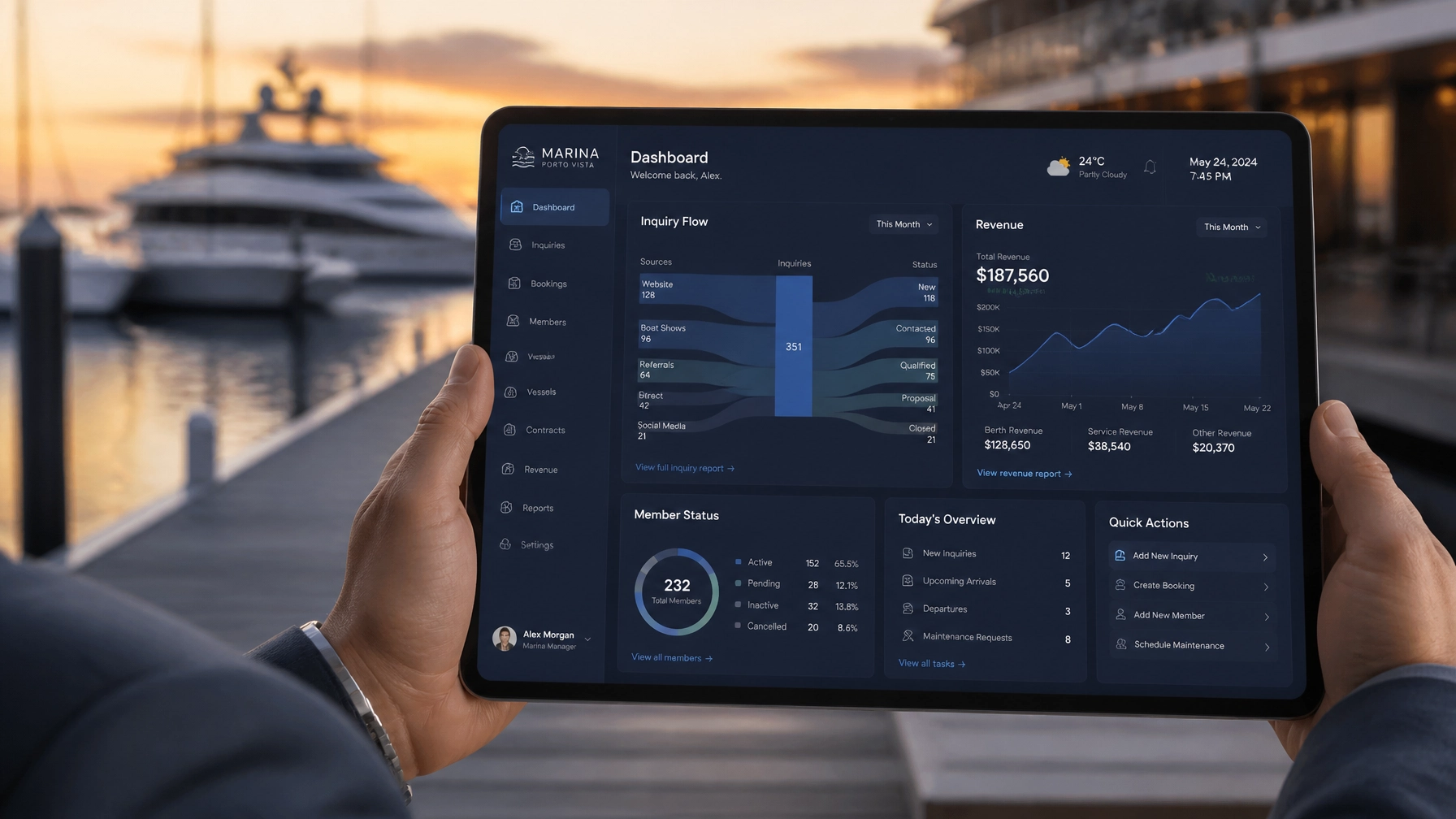
Step 4 is about funneling every website inquiry into a single Revenue-Focused Control Panel.
- CRM Integration: Every inquiry should automatically create a contact profile in your CRM. This allows you to track the member journey from the first click to the final payment.
- Eliminate Manual Entry: Your staff should never have to copy-paste data from an email into a spreadsheet. Automation ensures that boat specs, contact info, and requested dates are already in the system when the dockmaster opens the file.
- Visibility: A unified dashboard allows you to see exactly where your leads are coming from: whether it’s your Google Business Profile, social media, or organic search.
By centralizing these "disconnected tools," you transform from a reactive manager into an architect of your marina’s growth.
Step 5: Leverage Visual Trust (Layer 5)
A boat is a major investment. Boaters won't commit to a seasonal slip or a complex repair service if they can't see the facility. High-conversion inquiry flows are fueled by Visual Trust Media.
Don't rely on grainy photos from five years ago. Your website should incorporate:
- 360° Tours: Let prospective members "walk" your docks from their living room.
- Drone Footage: Provide a bird's-eye view of your harbor, entrance channels, and amenities.
- High-Definition Media: Professional photography of your fuel docks, restrooms, and security measures.
As seen in our Lake Center Marina Case Study, visual storytelling isn't just about aesthetics; it’s about reducing the perceived risk for the customer. When a boater sees a well-maintained, modern facility, the "friction" of the inquiry disappears.

The Difference Between a Vendor and a Partner
Most software companies are vendors: they sell you a tool and leave you to figure out how to use it. At Pro Marina Partner, we are infrastructure partners.
We don't just hand you a website. We execute a complete business revamp. We learn your specific marina, map your workflows, and build a unified system that eliminates revenue leaks. We bridge the gap between software developers and dockhands because we understand the physical reality of running a marina.
Stop Guessing. Start Building.
If your marina looks better in person than it does online, you are losing money every single day. The gap between your physical excellence and your digital presence is where your competitors are winning.
Eliminate the fragmentation. Build your operating system. Transform your marina.
Contact Pro Marina Partner today to start your Phase 01 on-site audit and stop the revenue leaks.
Leave a Reply